Vibe Dharm
Sanatan Dharma for Beginners: Simple Concepts Everyone Should Know
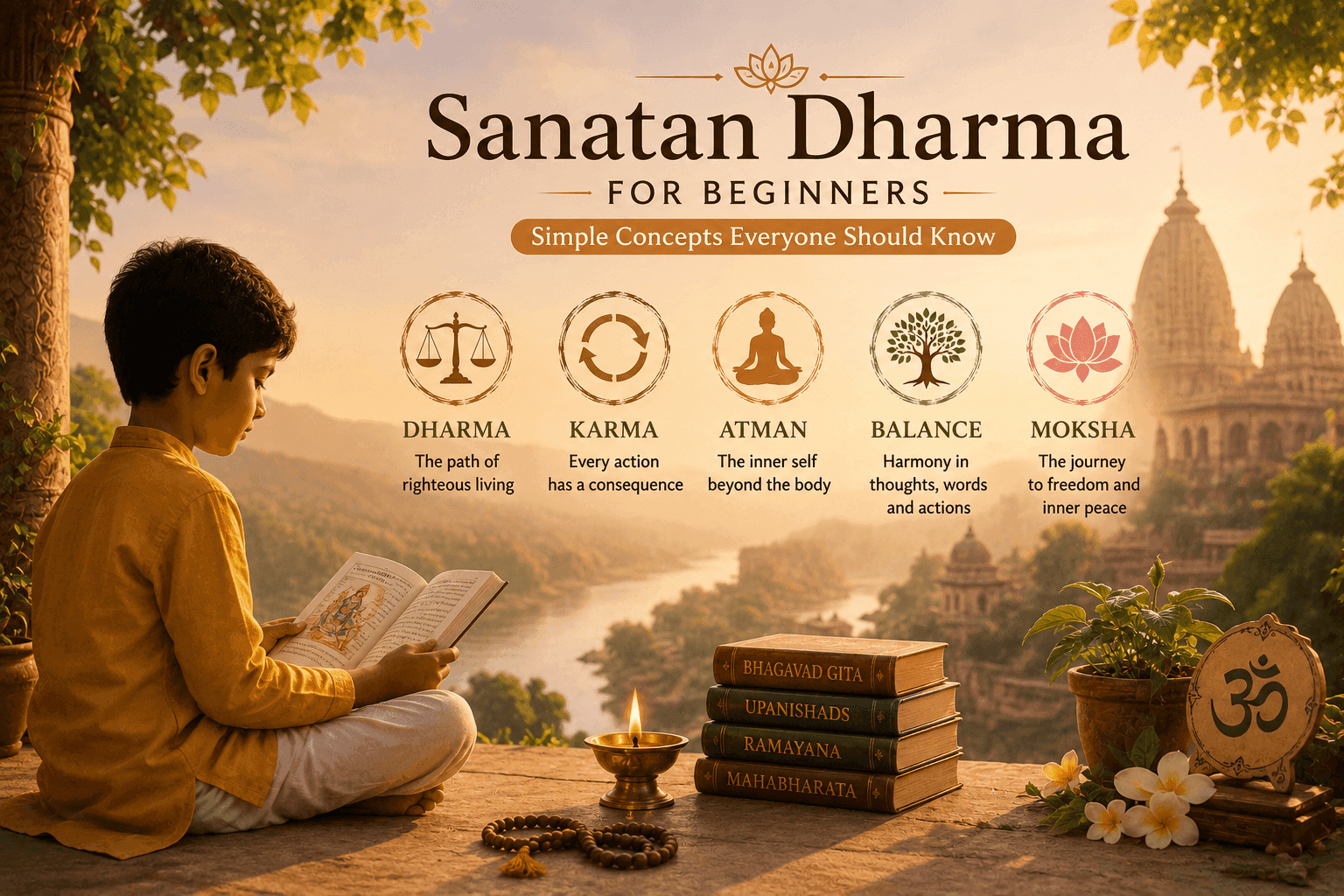
Curious about Sanatan Dharma? This beginner-friendly guide explains key ideas like Dharma, Karma, and balance in a clear and practical way.
A Beginner’s Guide to Sanatan Dharma in Modern Life:
Understanding the Timeless Philosophy Behind Dharma, Karma, Meditation & Inner Peace
Modern life often feels fast, stressful, and emotionally exhausting.
Many people today are searching for:
- deeper meaning
- inner peace
- mindfulness
- spiritual understanding
- cultural connection
That is one reason interest in Sanatan Dharma has grown again among younger generations around the world.
For beginners, however, Sanatan Dharma can sometimes seem difficult to understand because of its vast history, scriptures, traditions, and philosophies.
But the core ideas are actually surprisingly practical.
At its heart, Sanatan Dharma teaches people how to live with:
- awareness
- responsibility
- balance
- compassion
- self-discipline
- inner growth
For generations, these teachings were passed through stories, family traditions, festivals, daily habits, and spiritual practices across India.
This beginner-friendly guide explains some of the most important concepts of Sanatan Dharma in a simple and practical way.
What Is Sanatan Dharma?
The phrase Sanatan Dharma is commonly translated as:
- “the eternal way”
- “the timeless truth”
- “the eternal order”
Unlike religions founded by a single historical figure, Sanatan Dharma evolved gradually over thousands of years through sages, philosophers, spiritual teachers, and ancient Indian traditions.
For many practitioners, it is not seen only as a religion.
It is understood as a way of life that guides how people interact with:
- themselves
- family
- society
- nature
- the universe
Its teachings are preserved in ancient texts such as:
- the Vedas
- Upanishads
- Ramayana
- Mahabharata
- Bhagavad Gita
Traditionally, much of this wisdom was also shared through storytelling, observation, and daily life practices inside Indian households.
That is one reason Sanatan Dharma has remained relevant across generations.
Why Are Young People Becoming Interested in Sanatan Dharma Again?
In today’s digital world, many people feel:
- mentally overwhelmed
- disconnected from purpose
- emotionally restless
- constantly distracted
As a result, younger generations are increasingly exploring:
- mindfulness
- yoga philosophy
- meditation
- Bhagavad Gita teachings
- Vedic wisdom
- spiritual self-awareness
Many people are not necessarily searching for complicated rituals.
Instead, they are looking for:
- clarity
- emotional balance
- meaningful values
- practical spirituality
- inner peace
That is why the teachings of Sanatan Dharma continue to feel surprisingly relevant even today.
1. Dharma: The Idea of Right Living
One of the most important concepts in Sanatan Dharma is Dharma.
Dharma is often translated as:
- duty
- righteousness
- moral responsibility
- right conduct
But Dharma is not simply about following strict rules.
It is more about acting responsibly according to one’s role, circumstances, and conscience.
For example:
- A student’s dharma is to learn sincerely
- A teacher’s dharma is to guide honestly
- A parent’s dharma is to nurture and protect
- A leader’s dharma is to serve fairly
In Indian epics like the Mahabharata and Ramayana, characters constantly face difficult choices where Dharma is not always simple or obvious.
This reflects an important idea:
Life is complex, and wisdom often requires thoughtful action rather than blind obedience.
For many people today, Dharma can be understood as living with integrity and awareness in everyday life.
If you enjoy learning through stories, explore our Indian Mythology Story Cards designed for both children and adults.
2. Karma: Every Action Creates Consequences
Another foundational concept is Karma.
Karma literally means “action.”
Many people mistakenly think Karma only refers to fate or punishment.
In Sanatan Dharma, Karma is understood more deeply as the natural relationship between actions and consequences.
The principle teaches that:
- positive actions create positive effects
- harmful actions eventually create suffering
- intentions behind actions also matter
This idea encourages mindfulness and personal responsibility.
Instead of acting impulsively, people are encouraged to think about how their choices affect themselves and others.
Even small actions like honesty, kindness, patience, anger, or selfishness shape future experiences over time.
For beginners, Karma is often one of the easiest and most practical teachings to understand because it applies directly to daily life.
3. Atman: Understanding the Inner Self
Sanatan Dharma teaches that every individual has an inner self called Atman.
The Atman is not:
- the body
- appearance
- emotions
- social identity
It is the deeper consciousness that exists beyond temporary life experiences.
Many spiritual practices in Indian traditions, including meditation, prayer, chanting, and self-reflection, are meant to help people become more aware of this inner self.
One of the most powerful teachings of Sanatan Dharma is that the same divine essence exists within all beings.
This understanding encourages:
- compassion
- humility
- respect for life
- reduced ego-centered thinking
For many spiritual seekers, inner growth begins not by controlling the outside world, but by understanding the self more clearly.
4. The Four Goals of Life in Sanatan Dharma
Sanatan Dharma teaches balance rather than extreme rejection of worldly life.
Traditional philosophy often explains life through four important goals known as the Purusharthas.
Dharma
Living ethically and responsibly.
Artha
Earning wealth and security honestly.
Kama
Experiencing happiness, relationships, creativity, and emotional fulfillment.
Moksha
Seeking spiritual freedom and inner liberation.
Together, these four goals encourage a balanced life that includes both material well-being and spiritual wisdom.
This balanced approach is one reason many people still find Sanatan Dharma practical for modern life.
Why Stories Are Important in Sanatan Dharma
One of the most beautiful aspects of Sanatan Dharma is that spiritual wisdom is often taught through stories.
For centuries, teachings were passed through:
- epics
- storytelling traditions
- festivals
- family conversations
Texts such as:
- Ramayana
- Mahabharata
- Bhagavad Gita
- Panchatantra
continue to teach lessons about:
- courage
- devotion
- truth
- discipline
- loyalty
- compassion
- moral choices
In many Indian households, children first learned values through bedtime stories and observing elders rather than formal philosophy lessons.
That storytelling tradition still remains powerful today.
How Beginners Can Start Learning Sanatan Dharma
Many beginners assume they must immediately read complex scriptures.
But learning often starts much more simply.
You can begin by:
- reading beginner-friendly versions of the Bhagavad Gita
- listening to spiritual stories
- practicing meditation or self-reflection
- learning about Indian philosophy gradually
- observing values like honesty, patience, and discipline in daily life
Sanatan Dharma is traditionally understood as a lifelong journey of learning and self-awareness, not something mastered in a few days.
Curiosity and sincerity matter more than perfection.
Why Sanatan Dharma Still Matters in Modern Life
The teachings of Sanatan Dharma continue to resonate because they address timeless human concerns such as:
- stress
- purpose
- relationships
- self-control
- ethics
- inner peace
Rather than focusing only on rituals, the philosophy encourages:
- mindfulness in actions
- balance in life
- responsibility toward others
- respect for nature
- self-awareness
In an increasingly distracted world, these teachings often feel grounding and emotionally calming.
FAQs About Sanatan Dharma
Is Sanatan Dharma the Same as Hinduism?
Many people use the terms interchangeably, though Sanatan Dharma traditionally refers to the broader eternal philosophy and way of living underlying Hindu traditions.
What Is the Main Teaching of Sanatan Dharma?
Some of the central ideas include Dharma (right living), Karma (actions and consequences), self-awareness, balance, and spiritual growth.
Can Beginners Learn Sanatan Dharma Easily?
Yes. Many beginners start through stories, simple explanations of philosophy, meditation, and teachings from the Bhagavad Gita.
Does Sanatan Dharma Encourage Meditation?
Yes. Meditation, self-reflection, prayer, and mindfulness are important practices in many traditions connected with Sanatan Dharma.
Why Are Young People Interested in Sanatan Dharma Today?
Many younger people are exploring Sanatan Dharma for spiritual understanding, emotional balance, mindfulness, cultural connection, and deeper meaning in modern life.
Final Thoughts
Sanatan Dharma has continued for thousands of years because its teachings explore timeless questions about life, responsibility, consciousness, and inner peace.
At its core, it encourages people to live with greater awareness toward:
- their actions
- relationships
- thoughts
- responsibilities
- spiritual growth
For beginners, the journey does not need to begin with complexity.
Sometimes it begins simply with curiosity:
- reading stories
- asking questions
- reflecting deeply
- becoming more mindful in everyday life
And over time, those small steps can become a meaningful exploration of one of the world’s oldest living philosophical traditions.